ProjectsFlagship
ChantiePro
16 Spring Boot 3.3 services on Java 21, 6 shared libraries, 31 Flyway migrations, Kafka, Angular 18.
Overview
A personal engineering project that models a construction firm as thirteen business services plus three platform services. Each service owns a private PostgreSQL schema. Changes that other parts of the system must react to travel as Kafka domain events. An Angular 18 workspace in Nx sits on top; Prometheus, Grafana, Loki and Zipkin sit underneath.
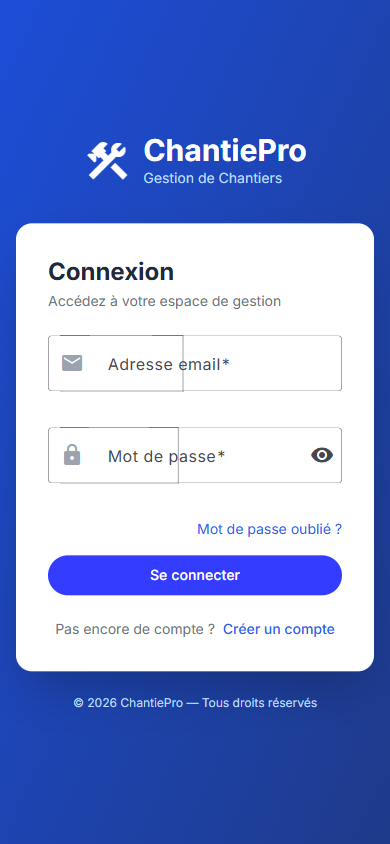
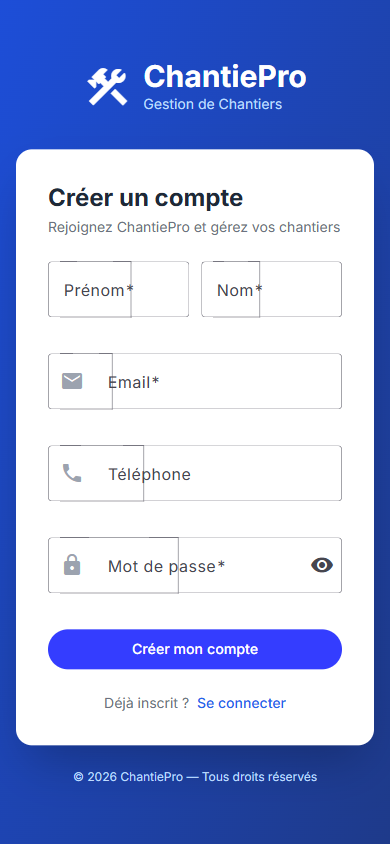
Interface
Problem
A construction site behaves like a small business: materials arrive and are consumed, equipment moves between sites, crews clock in, expenses need approval, and every event has to reconcile against a project budget. Putting that in one monolith couples every change. The goal was to decompose a real domain into independently deployable services and still ship a coherent UI.
Technical solution
Requests enter a Spring Cloud Gateway that validates the JWT once and forwards the authenticated principal. Services discover each other through Eureka and load configuration from a config server. Anything another bounded context must observe — a project changing status, an expense being approved — is published to Kafka instead of being handled with a synchronous call. Data is organisation-scoped via an organizationId in the JWT, applied at the query layer. That is not a hardened multi-tenant isolation model.
Architecture
01
Angular 18 · Nx
NgRx Signal Store
02
API Gateway :8080
JWT, routing, CORS
03
Eureka + Config
:8761 · :8888
Business services
auth :8081
Registration, login, roles
user :8082
Profiles and organisations
referentiel :8083
Categories, units
project :8084
Projects, milestones
material :8085
Stock and movements
equipment :8086
Register and assignments
hr :8087
Employees, attendance
expense :8088
Capture and approval
finance :8089
Invoices, budgets
notification :8090
In-app and email
document :8091
PDF, Excel, Word
file :8092
MinIO uploads
audit :8093
Trail and history
Kafka → notification, audit, finance · PostgreSQL 16 · Redis · MinIO · Prometheus / Grafana / Loki / Zipkin
What is in the repository
- Thirteen business services and three platform services (gateway, Eureka, config server) on Java 21 and Spring Boot 3.3
- Six shared libraries for DTOs, security, Kafka, audit, exceptions and web filters
- Schema-per-service PostgreSQL 16 with Flyway migrations
- Kafka domain events consumed by notification, audit and finance
- Redis cache, MinIO object storage, springdoc OpenAPI
- Angular 18 in an Nx monorepo with NgRx Signal Store
- Prometheus, Grafana, Loki and Zipkin
- CI: Maven tests on JDK 21 including Testcontainers/Flyway integration tests, Nx production build, Compose validation
Technical decisions
- Schema per service, not a shared database
- Each service owns its tables. There are no cross-service joins. That keeps deployability real; it also forces every collaboration between services to be an explicit API or an event.
- Events for reactions, REST for commands
- Synchronous REST stays inside a use case the caller is waiting on. Audit and notification never need to be on that path, so they subscribe.
- Shared libraries instead of copy-paste
- JWT filters, event envelopes and error shapes live in Maven modules. A new service inherits the platform’s conventions by declaring a dependency.